Bread Flour vs. All-Purpose Flour: Which One for Artisan Loaves?
Two bags sit side by side on the shelf. Both are white, both are finely milled, both promise good bread on the back label. One says bread flour; the other says all-purpose. You pick one up, put it down, pick up the other, and the honest question is: does it actually matter? It does, but not in the way most baking advice suggests. The difference isn't a secret trick or a hidden ingredient — it's a fairly simple matter of protein, and how that protein behaves once water and time get involved.
Two Flours From the Same Mill
Both flours start the same way: wheat is milled, the bran and germ are sifted out, and what's left is the starchy, protein-rich endosperm. The split happens at the wheat blend. Bread flour is milled mostly from hard wheat, which is dense and high in protein. All-purpose flour is a blend, often of hard and soft wheats, engineered to land somewhere in the middle so it can handle pancakes and pie crust as well as a loaf.
Mills also tweak things at the edges. Many bread flours carry a little malted barley flour to boost the enzymes that feed yeast, and most are unbleached. All-purpose flours vary much more between brands — some are bleached and bromated, some are enriched, some are nothing but flour. Two bags labeled all-purpose from different mills can behave like distant cousins.
Read the label, not the picture
Protein is printed on every nutrition panel, and you can read it as a percentage with a small calculation. If a 30 g serving of flour lists 4 g of protein, that's roughly 13 percent. If it lists 3 g, you're near 10 percent. Do that math in the aisle and you'll know more than the front of the bag tells you.
Protein Levels: The Working Numbers
As a general guide, all-purpose flour runs somewhere around 9.5 to 11.5 percent protein, while bread flour typically sits between 12 and 14 percent. That gap of two or three points sounds small. In a dough, it isn't.
Protein percentage describes potential, not performance. It tells you how much gluten-forming protein is present, not how good it is. Wheat variety, growing season, milling method and how long the flour has sat in your cupboard all change the outcome. A stone-milled artisan bread flour at 12 percent can feel livelier and thirstier than a commodity flour at 13. Treat the number as a starting point and let the dough correct you.
Protein tells you what a flour can do. The dough tells you what it is doing.
Gluten Strength in the Bowl
Hydrate both flours at 70 percent and mix them the same way, and the difference shows up in your hands within minutes. Bread flour hydrates slowly, then tightens into a smooth, elastic dough that pushes back. All-purpose flour takes water quickly and feels softer, more extensible, a little slack — it stretches easily but doesn't fight you.
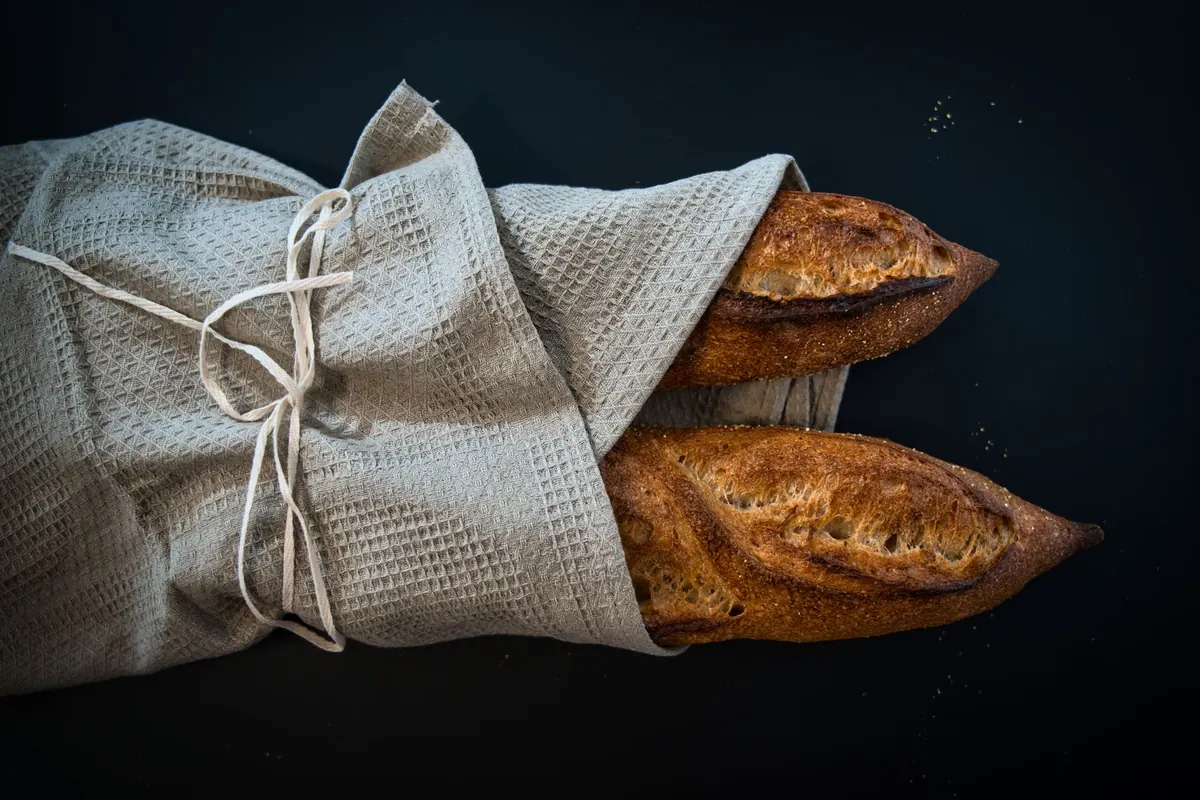
That strength has practical consequences. A strong bread flour will hold up to a long bulk fermentation, a cold retard overnight, three or four sets of stretch and folds, and a wetter dough than you'd dare with all-purpose. It traps gas well, which is why it produces the tall, domed loaves in the photos. All-purpose tolerates less abuse. Push it too far with high hydration and long fermentation and it starts to sag, spread and lose tension at shaping.
A windowpane test still works as a check. Stretch a small piece thin between your fingers. Both flours will get there; bread flour gets there with a finer, stronger membrane and forgives you if you're rough.
Crumb, Crust and Chew
Cut into two loaves made from the same recipe with different flours and you'll see the split clearly.
- Bread flour: more oven spring, a more open and irregular crumb, a chewier bite, and a crust that browns deeply and stays crisp longer.
- All-purpose: a tighter, more even crumb, a tenderer texture, a softer and thinner crust, and slices that hold together neatly for sandwiches.
Neither is better. An open crumb suits a country sourdough you tear and dip in olive oil. A close, even crumb suits toast, sandwiches and anything you want to spread butter on without it falling through. If your all-purpose sourdough comes out flatter than the pictures online, it's usually not your starter's fault — you're asking a flour to hold gas it was never built to hold.
Where All-Purpose Quietly Wins
All-purpose is the better choice more often than bread-baking culture admits. Enriched doughs — brioche, milk bread, soft rolls, sandwich loaves — benefit from its tenderness; bread flour can make them lean towards chewy. Focaccia and pizza bianca often want a dough that stretches without snapping back. Flatbreads, pie crust, biscuits and quick breads have no use for extra gluten at all.
For everyday sourdough, a blend is the quiet workhorse: roughly 70 percent bread flour to 30 percent all-purpose gives you structure and tenderness in the same loaf. Try it once and you may stop keeping two separate recipes.
Adjusting When You Swap
Recipes assume a flour. If you change it, change something else.
- Hold back water. Reserve 5 to 8 percent of the liquid and add it gradually. All-purpose usually needs less; bread flour often needs more.
- Autolyse. Thirty to sixty minutes of flour and water resting together before salt and starter improves extensibility in both cases and makes weaker flour easier to handle.
- Use folds instead of kneading. All-purpose flour responds better to gentle stretch and folds spaced twenty to thirty minutes apart than to ten minutes in a mixer.
- Shorten the bulk if the dough slackens. Weak flour degrades faster. Move it to the fridge earlier rather than pushing fermentation for volume it can't hold.
- Keep the dough cooler. Cooler water and a cooler kitchen slow everything down, which buys weaker flour time to build strength.
- Consider vital wheat gluten. A small addition can lift all-purpose flour towards bread flour behaviour. Follow the package directions; a common starting point is about a tablespoon per cup of flour.
Choosing for Your Kitchen
Buy both if you bake often. A bag of bread flour and a bag of all-purpose will cover everything from a wet, high-hydration country loaf to Friday's sandwich bread, and neither will sit long enough to go stale. Store them in a cool, dry place in a sealed container, and use them within a few months of opening — flour loses strength quietly.
Match the flour to the loaf you actually want to eat. Lean dough, high hydration, long fermentation, open crumb: bread flour. Softer sandwich loaves, enriched doughs, flatbreads and anything spread with butter: all-purpose. And when you're unsure, blend. Keep a short note with each bake — flour, hydration, timings, how the dough felt — and within a few loaves you'll have a record more useful than any general rule, including this one.
Photo: webandi / Pixabay